

This page discusses Machined Steel Bar and Plate compared to Forging - fatigue, stress, corrosion, machining, material grain pattern,
grain structure, strength, ductility, resistance, flame cutting plate, rings, hubs, turning, grinding, polishing, surface irregularities, dimensional accuracy, machinability -
Queen City Forging - Custom Forging.


Alloy steel forging to Cold heading


Cold working to Flashless forging


Flow lines to Isothermal forging


Machine forging to Rig-and-web forging


Ring rolling to Wide tolerances


Compare Forging to Casting


Compare Forging to Reinforced Plastics and Composites (RP/C)


Compare Forging to Weldments/Fabrications


Compare North American Forges to Offshore Competition


Compare Forging to Powder Metallurgy (P/M)


Compare Forging...


Broader size range of desired material grades.


to Machined Steel Bar/Plate


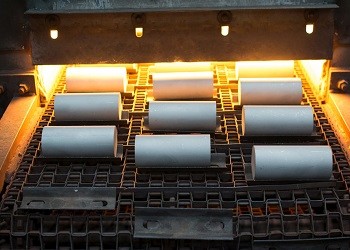
Sizes and shapes of products made from steel bar and plate are limited to the dimensions in which these materials are supplied. Often, forging may be the only metal working process available with certain grades in desired sizes. Forgings can be economically produced in a wide range of sizes - from parts whose largest dimension is less than 1 in. to parts weighing more than 450,000 lbs.


Grain oriented to shape for greater strength.


Machined bar and plate may be more susceptible to fatigue and stress corrosion because machining cuts material grain pattern. In most cases, forging yields a grain structure oriented to the part shape, resulting in optimum strength, ductility and resistance to impact and fatigue.


Better, more economical use of materials.


Flame cutting plate is a wasteful process - one of several fabricating steps that consumes more material than needed to make such parts as rings or hubs. Even more is lost in subsequent machining.


Lower scrap; greater, more cost-effective production.


Forgings, especially near-net shapes, make better use of material and generate little scrap. In high-volume production runs, forgings have the decisive cost advantage.


Fewer secondary operations required.


As supplied, some grades of bar and plate require additional operations - such as turning, grinding and polishing - to remove surface irregularities and achieve desired finish, dimensional accuracy, machinability and strength. Often, forgings can be put into service without expensive secondary operations.


Return Home


Queen City Forging


235-B Tennyson St. - Cincinnati, Ohio 45226
(513) 321 - 7200 - Fax (513) 321 - 2004 - (888) 321 - 7200

Requests for Quotation: sales@qcforge.com

Requests for Technical Assistance: Contact Us

Link to QCF's Area Map

Need help finding us? Link to MapQuest

Copyright 1997-2008 Queen City Forging
Site Design and Maintained by: Slaughter and Slaughter, Inc.

This page discusses Machined Steel Bar and Plate compared to Forging - fatigue, stress, corrosion, machining, material grain pattern,
grain structure, strength, ductility, resistance, flame cutting plate, rings, hubs, turning, grinding, polishing, surface irregularities, dimensional accuracy, machinability -
Queen City Forging - Custom Forging.